
“While” is one of those small words that does a lot of work in English. It can mean “during the same time as,” “although,” or even “a short period of time,” depending on how it’s used. Because of that, the best synonym for “while” really depends on which job it’s doing in your sentence.
Quick Answer: Synonyms of While
There’s no single word that replaces “while” in every sentence, because “while” changes meaning based on context.
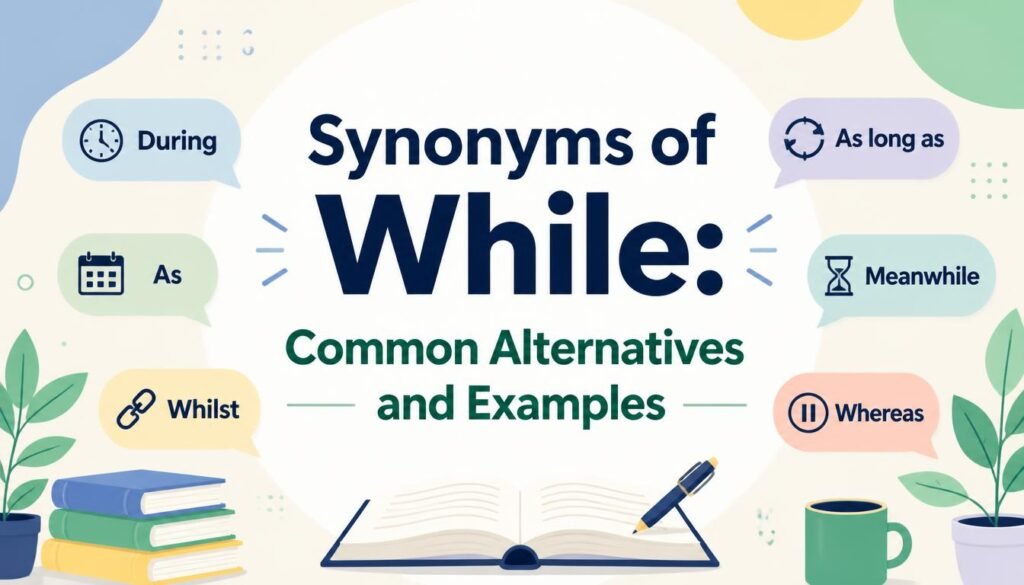
- To mean “during the same time as”: use during, as, when, whilst
- To mean “although” or “whereas”: use whereas, although, though, even though
- To mean “a period of time” (noun): use time, period, spell, stretch, interval, moment
Picking the right one just means knowing which version of “while” you’re actually using.
What Is the Meaning of While?
“While” has two main jobs in English: it works as a conjunction and as a noun.
As a conjunction, it usually means “during the time that” something else happens, like in “She read while he cooked.” It can also mean “although” or “whereas,” as in “While I agree, I still have concerns.”
As a noun, “while” refers to a period of time, often a short or unspecified one — think “Let’s talk for a while” or “It’s been a while since we met.”
That double meaning is exactly why “while” doesn’t have one perfect synonym. The right replacement depends on which function it’s playing.
What Is a Synonym for While?
The most common synonyms for “while” fall into three groups: time-related conjunctions (during, as, when), contrast conjunctions (whereas, although), and time-period nouns (time, spell, stretch).
None of these are interchangeable in every sentence. A word that works for “while I was cooking” won’t necessarily work for “while I disagree with you.” Choosing the right one keeps your writing clear and natural.
20+ Synonyms for While
Here’s a working list of alternatives, organized by what “while” is doing in the sentence.
| Synonym | Meaning | Best Used For |
|---|---|---|
| During | At the same time as an event | Formal or neutral writing |
| As | At the same moment as | Everyday writing and speech |
| When | At the time that | Casual, everyday sentences |
| Whilst | Same as “while” (British English) | Formal or British-style writing |
| Whereas | Showing contrast between two facts | Formal, comparative writing |
| Although | Despite the fact that | Academic or formal contrast |
| Though | Casual version of “although” | Conversational writing |
| Even though | Stronger contrast than “although” | Emphatic contrast |
| But | Simple contrast | Everyday speech |
| Time | A general stretch of time | Neutral, everyday use |
| Period | A defined stretch of time | Formal or academic writing |
| Spell | A short, informal stretch of time | Casual conversation |
| Stretch | An extended, continuous period | Descriptive or narrative writing |
| Interval | A gap or pause between events | Technical or formal contexts |
| Moment | A brief point in time | Everyday and literary writing |
| Duration | The length of time something lasts | Formal or technical writing |
| Span | A measured length of time | Formal, especially in data or reports |
| Meanwhile | At the same time (as a separate event) | Storytelling and narrative transitions |
| Simultaneously | At the exact same time | Formal or technical writing |
| Concurrently | Happening at the same time | Legal, academic, or business writing |
| Bit (a bit) | A short amount of time, informal | Casual conversation |
Not every word here is a true one-to-one match for “while.” Some, like “meanwhile” and “simultaneously,” work best as transition words rather than direct substitutes inside a sentence.
Best Synonyms for While by Context

While Meaning “A Period of Time”
When “while” is a noun, good alternatives include time, spell, stretch, interval, and moment. “Spell” feels casual, while “interval” and “duration” sound more formal or technical.
Example: “Stay a while” becomes “Stay a spell” (casual) or “Stay for a short period” (formal).
While Meaning “During”
When “while” links two things happening at once, during, as, and when are the most natural replacements. “During” pairs with nouns (“during the meeting”), while “as” and “when” pair with full clauses (“as the meeting started”).
Example: “While the meeting was happening” becomes “During the meeting” or “As the meeting was happening.”
While Meaning “Although” or “Whereas”
For contrast, whereas, although, though, and even though all work well. “Whereas” tends to sound more formal and analytical, while “though” feels conversational.
Example: “While I understand your point, I disagree” becomes “Although I understand your point, I disagree.”
While in Formal or Academic Writing
Academic and business writing often favors whereas, during, concurrently, and duration because they sound precise and objective.
While in Everyday Conversation
In casual speech, people naturally reach for as, when, though, and a bit — words that sound relaxed rather than technical.
While Synonyms With Example Sentences
During: She stayed quiet during the presentation.
As: The phone rang as I was leaving the house.
When: He called me when I was on the train.
Whilst: Whilst I appreciate the offer, I’ll have to decline.
Whereas: He prefers coffee, whereas she prefers tea.
Although: Although it was raining, they went for a walk.
Though: It’s a good plan, though it needs more detail.
Spell: We sat on the porch for a spell before dinner.
Stretch: He worked a long stretch without a single break.
Interval: There was a short interval between the two songs.
Meanwhile: She finished her homework; meanwhile, her brother watched TV.
Simultaneously: The two teams finished the race simultaneously.
While vs. Whereas: What’s the Difference?
“While” and “whereas” can both show contrast, but “whereas” sounds more formal and is almost always used for contrast, not time. “While” is more flexible and can mean either “during” or “although,” which sometimes makes a sentence ambiguous.
If you want a sentence to sound clearly analytical or comparative, “whereas” is usually the safer, more precise choice.
While vs. During: What’s the Difference?
“During” is a preposition, so it needs a noun right after it — “during the movie,” not “during she watched.” “While” is a conjunction, so it connects to a full clause — “while she watched the movie.”
A simple test: if you can’t finish the sentence with just a noun, you need “while,” not “during.”
While vs. Although: What’s the Difference?
“Although” always signals contrast — it never means “during the same time.” “While” can mean either “during” or “although,” depending on context, which makes “although” the clearer choice when contrast is your only intended meaning.
Using “although” instead of “while” for contrast helps avoid confusing readers about whether you mean timing or disagreement.
Synonyms of While for Writing
Different types of writing call for different tones:
- Essays and academic writing: whereas, during, concurrently
- Creative writing: meanwhile, spell, stretch, moment
- Travel or narrative writing: during, as, meanwhile
- Professional or business writing: during, whereas, duration
- Everyday captions or casual notes: a bit, for a while, as
Matching the synonym to the tone of your piece makes the writing feel natural instead of forced.
What Is the Best Synonym for While?
There isn’t one universal winner — the best word depends on what “while” is doing in your sentence.
- During → linking an event to a specific time period
- Whereas → drawing a clear contrast between two ideas
- Although → softening or introducing disagreement
- Spell / stretch → describing a casual period of time
- Meanwhile → shifting between two things happening at once
Think about whether you need timing, contrast, or duration before picking your word.
Contrasting Words and Concepts
“While” is a function word, so it doesn’t have a true opposite the way a word like “happy” has “sad.” Still, some contrasting ideas are worth knowing:
- Instead of — signals replacement rather than simultaneous timing
- Never — the opposite of an ongoing duration
- Instantly — the opposite of “for a while,” which implies a stretch of time
These aren’t antonyms in the strict dictionary sense, but they’re useful contrasts when you’re trying to express the opposite idea.
Frequently Asked Questions
What is a synonym for while? It depends on meaning: “during” or “as” for timing, “whereas” or “although” for contrast, and “spell” or “stretch” for a period of time.
What is another word for while? Common alternatives include during, as, when, whereas, although, and moment, depending on context.
What is a synonym for “while” meaning “although”? Whereas, although, though, and even though all work well for contrast.
What is a synonym for “while” meaning “a period of time”? Time, spell, stretch, interval, and duration are good replacements for this noun sense.
Is “during” a synonym for while? Yes, but only when “while” is used to mean “at the same time as.” “During” needs a noun after it, unlike “while.”
Is “whereas” the same as “while”? They overlap when showing contrast, but “whereas” is more formal and only used for contrast — never for timing.
What is a formal word for while? Whereas, during, and concurrently sound more formal than casual options like “a bit” or “spell.”
What is a British word for while? “Whilst” is a common British English alternative to “while,” used the same way.
What is the difference between while and when? “When” often points to a specific moment, while “while” suggests an ongoing action happening at the same time.
What is the opposite of while? “While” doesn’t have a direct antonym, but words like “instead of,” “never,” and “instantly” express contrasting ideas depending on context.
Conclusion
If you’re working on building a stronger vocabulary overall, small function words like “while” are just one piece of the puzzle — descriptive words matter just as much. For example, if you’re writing about travel, exploration, or an exciting experience, it helps to know your options beyond the obvious choice; our guide on Synonym for Adventure breaks down words like venture, escapade, and expedition so you can pick the one that fits your story.
Once you get comfortable with that split, choosing between “during,” “whereas,” “although,” or “a spell” becomes second nature. Your writing ends up sounding more precise, and readers never have to guess which meaning you intended.