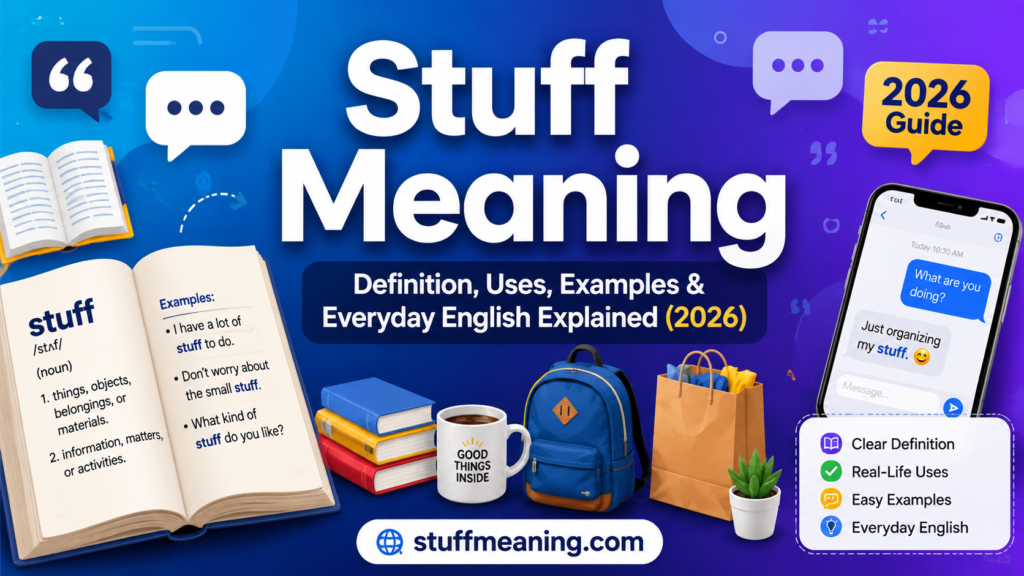

Have you ever heard someone say “I have a lot of stuff to do” or “Where is my stuff?” and wondered what the word “stuff” actually means?
Stuff is a common English word used to describe things, objects, materials, information, activities, or general matters without naming them specifically. It is very common in everyday conversations, texting, and informal writing.
Quick Answer: Stuff Meaning?
Stuff generally means things, objects, materials, or matters that are not being identified specifically.
For example:
Here, “stuff” means personal belongings such as clothes, shoes, or other items.
The word can also refer to non-physical things:
In this sentence, “stuff” means tasks, activities, or responsibilities.
In simple terms: “stuff” is a general word for things or matters.
What Does “Stuff” Mean in English?
In English, stuff is a flexible word with several related meanings.
It can refer to:
- Physical objects
- Personal belongings
- Materials or substances
- Information
- Topics or matters
- Work or tasks
- Activities
- Personal situations
The exact meaning comes from the context.
Unlike a specific word such as “books,” “clothes,” or “documents,” “stuff” does not tell you exactly what is being discussed. It is useful when the individual items are unknown, unimportant, or too numerous to list.
Stuff Meaning in Simple Words
In simple English, stuff means “things.”
However, “stuff” is usually more general than “things.” It can describe a group of objects or even non-physical matters.
For example:
- My stuff = my belongings
- Work stuff = work-related matters
- School stuff = school-related things
- Personal stuff = private matters
- Food stuff = food or food-related materials
This makes “stuff” a convenient word when you do not need to give every detail.#
How Is “Stuff” Used in Everyday English?
“Stuff” is extremely common in everyday spoken English.
People use it when talking about many different areas of life, including:
- Home and personal belongings
- Work and school
- Hobbies
- Food and drinks
- Problems and situations
- Information
- Activities
- Personal matters
For example, someone might say:
Here, “stuff” refers generally to work-related tasks or matters.
The word is especially useful in casual conversations because it sounds natural and does not require the speaker to list every detail.
Stuff as a Noun
The most common use of stuff is as a noun.
As a noun, it can refer to objects, possessions, materials, information, or general matters.
Physical Objects
“Stuff” can mean a person’s belongings or a collection of objects.
Here, the speaker is referring to belongings without naming each item.
Materials or Substances
Stuff can also describe a material or substance when its exact name is unknown or unimportant.
For example, someone might ask what a particular substance on a surface is by saying:
“What is this stuff?”
Topics or Matters
“Stuff” can refer to non-physical subjects as well.
For example, “personal stuff” can mean private matters, while “serious stuff” can refer to important or difficult topics.
Is “Stuff” Countable?
When “stuff” means a collection of things, it is normally an uncountable noun.
We commonly say:
- Some stuff
- A lot of stuff
- Too much stuff
- My stuff
- Your stuff
We generally do not say “many stuffs” when referring to ordinary things.
If you need to count individual objects, use words such as things, items, or pieces instead.
Stuff as a Verb
“Stuff” can also function as a verb.
As a verb, it generally means to put something into a space, often tightly or in a large amount.
For example:
Here, “stuffed” means she put the clothes into the bag, likely filling it tightly.
The verb can also appear in informal expressions such as “stuff your face,” which means to eat a large amount of food.
Because some expressions using “stuff” are informal, they are more suitable for conversations than formal writing.
Examples of “Stuff” in Everyday Sentences
Only a few examples are needed to understand the main uses of the word:
Personal belongings:
General activities:
Material or substance:
These examples show how the same word can refer to belongings, activities, or materials depending on the context.
Stuff Meaning in Texting and Casual Conversations
In texting, stuff usually has the same meaning as it does in everyday spoken English.
It is common because it is short, flexible, and informal.
You may see phrases such as:
- My stuff — my belongings
- Your stuff — your belongings or matters
- Some stuff — unspecified things
- That stuff — previously mentioned things or matters
- Stuff like that — similar things
- All that stuff — a group of things already discussed
For example:
Here, “stuff” can refer to different activities, responsibilities, problems, or situations.
“Stuff” itself is not internet slang. It is a normal English word that is frequently used in casual digital communication.
Common Phrases With “Stuff”
The word “stuff” appears in many everyday expressions.
Stuff Like That
“Stuff like that” means things similar to something already mentioned.
It is commonly used when giving a general description rather than listing every related item.
Stuff Happens
“Stuff happens” means that unexpected or unpleasant situations sometimes occur.
It is a softer version of the more vulgar expression “shit happens.”
Know Your Stuff
If someone “knows their stuff,” they are knowledgeable or skilled in a particular subject.
Good Stuff
“Good stuff” can describe something that is good, useful, enjoyable, or impressive.
The exact meaning depends on the situation.
Personal Stuff
“Personal stuff” usually refers to private matters, personal belongings, or situations related to someone’s private life.
Stuff vs. Things: What’s the Difference?
“Stuff” and “things” are closely related, but they are grammatically different.
Stuff is generally uncountable and refers to a general collection or amount.
Things is the plural form of “thing” and is countable.
| Word | Grammar | Typical Use |
| Stuff | Usually uncountable | A general collection or amount |
| Things | Countable plural | Individual objects, items, or matters |
For example:
This refers generally to a collection of belongings.
This refers to three specific tasks.
Is “Stuff” Formal or Informal?
Stuff is mainly a neutral-to-informal word.
It is completely normal in:
- Everyday conversations
- Text messages
- Social media
- Casual emails
- Informal writing
However, it can be too vague for formal or professional communication.
For example, instead of saying:
“Please send me the stuff.”
A professional message would be clearer if it said:
“Please send me the documents.”
The second version identifies exactly what is needed.
So, “stuff” is not incorrect in formal situations, but a more precise word is usually better.
Synonyms for “Stuff”
The best synonym depends on the meaning of “stuff” in the sentence.
When It Means Objects
- Things
- Items
- Belongings
- Possessions
- Objects
When It Means Material
- Substance
- Material
- Matter
- Content
When It Means Topics or Matters
- Matters
- Issues
- Topics
- Details
- Information
When It Means Work or Activities
- Tasks
- Work
- Activities
- Responsibilities
Using a more specific synonym can make your meaning clearer.
Common Mistakes to Avoid
Using “Stuffs” for Ordinary Things
When “stuff” means a general collection of things, it is normally uncountable.
Instead of:
Use:
>
Or:
Using “Stuff” When a Specific Word Is Better
“Stuff” can sometimes make writing vague.
If you know that you mean files, documents, clothes, tools, or tasks, it is often better to use the exact word.
Thinking Stuff Only Means Objects
Stuff does not only refer to physical belongings. It can also refer to information, work, activities, topics, problems, or personal matters.
Overusing Stuff in Formal Writing
Using “stuff” repeatedly can make professional or academic writing sound vague.
When precision matters, replace it with a more specific noun.
Frequently Asked Questions About “Stuff”
What does “stuff” mean in simple English?
“Stuff” generally means things, objects, materials, or matters when they are not being identified individually.
Is “stuff” a noun or a verb?
“Stuff” can be both. As a noun, it can mean things or material. As a verb, it can mean putting something into a space, often tightly.
Is “stuff” singular or plural?
“Stuff” is generally an uncountable noun when it means a collection of things. You normally say “some stuff” or “a lot of stuff,” not “many stuffs.”
What does “my stuff” mean?
“My stuff” usually means my belongings or personal things. Depending on the context, it can also refer to personal matters or activities.
What does “stuff like that” mean?
“Stuff like that” means things similar to what has already been mentioned.
Is “stuff” slang?
No. “Stuff” is a standard English word. It is simply more common in informal speech and casual communication.
Is “stuff” appropriate in formal writing?
It can be grammatically correct, but it is often too general for formal writing. More precise words such as “items,” “documents,” “materials,” or “information” are often better.
What is the difference between “stuff” and “things”?
“Stuff” usually refers to a general collection or amount and is uncountable. “Things” is countable and refers to individual objects, items, or matters.
Conclusion
Stuff is a common and flexible English word that generally means things, objects, materials, or matters.
Its exact meaning depends on the context. It can describe personal belongings, work, activities, information, substances, or personal matters. It can also be used as a verb when talking about putting something into a space.
In everyday conversation and texting, “stuff” sounds natural and informal. In professional or academic writing, however, a more specific word is often preferable.
The simplest way to understand “stuff” is to think of it as a general word for things or matters that do not need to be individually identified.
At Stuff Meaning, our goal is to make English words, internet slang, abbreviations, and everyday expressions easy to understand. Whether you’re looking for the meaning of common words like stuff, popular texting terms, or social media slang, you’ll find clear definitions, simple explanations, real-life examples, and helpful language guides to improve your understanding of English.