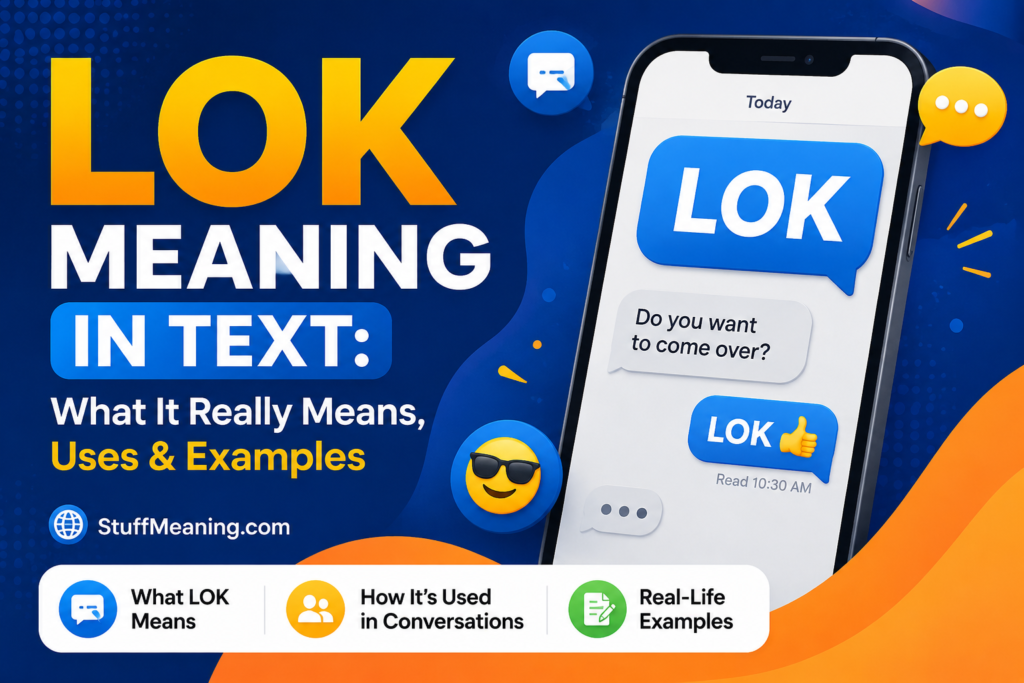

You’re scrolling through a chat and someone drops “LOK” like it’s obvious. It isn’t. You reread the message twice, maybe zoom in, and still land nowhere. Welcome to the club.
Texting slang moves fast, and three letters can carry more weight than an entire paragraph. LOK is one of those small words that quietly confuses a lot of people, which is exactly why “LOK meaning in text” shows up so often in search bars at 11 p.m.
This guide breaks down what LOK actually means, where the term comes from, how people use it across different apps, and how to reply without sounding lost. No filler, no guessing games — just a clear answer.
LOK Definition
In most modern texting, LOK is a clipped version of “low-key.” It works the same way “low-key” does in speech: it softens a statement, so the feeling comes across as casual instead of dramatic.
According to a standard English dictionary, low-key describes something quiet, relaxed, and not very forceful or noticeable. That’s the formal meaning. In texting culture, people stretch it a bit further and use it to mean “secretly” or “kind of.”
So when a friend texts “I’m LOK stressed about this exam,” they’re not filing an emotional report. They’re just admitting it without making a scene.
A smaller number of people also use LOK as a rushed typo for “look” or “lol,” especially on a phone keyboard where the letters sit close together. It’s worth knowing this version exists, but it’s the exception, not the rule.
What Does LOK Stand For?
LOK doesn’t have one official, dictionary-approved full form the way “LOL” stands for “laugh out loud.” It’s an informal shorthand, and shorthand rarely gets a rulebook.
That said, the version people actually use lines up like this:
|
Abbreviation |
Most Common Full Form | Formal or Slang |
| LOK | Low-Key |
Slang (adapted from a real adjective) |
|
LOK |
Look / LOL (typo) |
Slang / typing error |
The “Low-Key” reading wins by a wide margin in day-to-day chats, comment sections, and captions. The “look” or “lol” reading mostly happens by accident, not by design.
LOK Meaning in Text
Context decides everything with LOK. Here’s how it typically plays out.
As an intensity softener:
-
“This song is LOK a bop.” → I like this song more than I’m letting on.
-
“I’m LOK nervous for tomorrow.” → I’m nervous, but I don’t want to overreact.
As a quiet confession:
-
“I LOK miss him.” → I miss him, and I’m only sort of admitting it.
As a casual opinion:
-
“That was LOK the best meal I’ve had all year.” → Genuinely great, said lightly.
Notice the pattern: LOK almost always sits in the middle of a sentence, right before the real feeling. It’s rarely a standalone reply the way “lol” or “brb” is. That structural difference alone tells you a lot about which meaning you’re dealing with.
What Is the LOK Abbreviation? Read More Here
Since LOK isn’t a standardized abbreviation, the most reliable way to understand it is to trace it back to its full-length parent word: low-key. You can read the complete, dictionary-verified entry here.
Language trackers have also documented how low-key shifted from a plain adjective into an adverb in casual speech and online writing — the exact shift that eventually produced shorthand like LOK. So the abbreviation isn’t random internet noise. It’s a natural, traceable descendant of a word that’s been in English dictionaries for decades.
That’s a useful thing to remember next time someone tells you slang has “no rules.” It usually has a paper trail. You just have to look.
Other Meanings
Text slang rarely stays in its lane, and LOK is no exception. Outside of “low-key,” you’ll occasionally run into:
- A typo or fast-typing slip for “look” or “lol,” especially in group chats where everyone’s typing at top speed.
- A username or clan tag in gaming communities, where three-letter combos get recycled as team names.
- Someone’s initials, particularly in group projects, spreadsheets, or shared notes where full names get shortened.
- A regional or in-group code word that only makes sense to the specific friend group using it.
None of these alternate meanings are common enough to compete with “low-key” in everyday texting. But if a message doesn’t make sense with “low-key” swapped in, one of these is probably the real answer.
LOK Meaning in Social Apps
LOK shows up across nearly every major platform, and the meaning barely shifts — only the tone does.
Snapchat
Snaps are quick and disposable, so LOK often shows up as an honest aside. “LOK missed you today” reads as sincere without sounding heavy.
In captions and comments, LOK softens a bold statement. “LOK the best trip I’ve ever taken” feels confident but not try-hard.
TikTok
Comment sections lean into LOK for reactions. “LOK obsessed with this audio” is basically the TikTok version of admitting a guilty pleasure.
Because WhatsApp skews toward closer, ongoing conversations, LOK tends to appear in more personal admissions — “I’m LOK tired of this week” between close friends or family.
Discord and Gaming Chats
Here, watch for the outlier meaning. LOK can double as a tag, a bot command shorthand, or a nickname fragment, so read the surrounding messages before assuming it means “low-key.”
Across every app, the throughline stays the same: LOK takes the edge off a statement. It’s the text-speak equivalent of a shrug paired with a small, honest smile.
Origin & History of LOK
The story starts long before smartphones. “Low-key” has lived in English as an adjective for well over a century, originally describing something subdued, restrained, or lacking drama — think a “low-key celebration” or a “low-key manager.”
As texting culture accelerated in the 2010s, people began treating “low-key” less like an adjective and more like an adverb, dropping it into sentences to dial down the intensity of whatever came next. Dictionary trackers documented this exact shift, noting the word’s move into full-on adverbial use in casual and online writing.
From there, shortening was inevitable. Typing “low-key” every time takes effort nobody has at 1 a.m., so variations appeared: “lowkey” without the hyphen, “lk” for the truly impatient, and “LOK” as a middle-ground abbreviation that keeps enough letters to stay readable.
It hasn’t overtaken “lowkey” as the dominant spelling, and it probably never will. But it survives in comment sections and DMs precisely because texting rewards speed, and LOK gets the point across in a third of the keystrokes.
How to Reply to LOK
Replying is easier than decoding it in the first place.
Casual reply: “Same, honestly.” Playful reply: “Only low-key? Sounds like you’re highkey obsessed.” Neutral reply: “Makes sense.” Clarifying reply (if the context is unclear): “Wait, low-key or you mean look at something?”
That last option matters more than people expect. If a message genuinely could go either way, asking costs nothing and prevents an awkward mismatch later.
Common Mistakes People Make With LOK
A few misunderstandings pop up again and again:
- Assuming it’s always “lol.” The letters look similar, but the meanings rarely overlap.
- Treating it as formal shorthand. LOK has no dictionary entry of its own; it’s borrowed slang, not standardized abbreviation.
- Ignoring platform context. The same three letters mean something different in a gaming clan tag versus a Snapchat caption.
- Overthinking a simple typo. Sometimes someone really did just fat-finger “look.”
Reading the full sentence, not just the abbreviation, solves almost all of these mix-ups.
FAQs
What does LOK mean in a text message? It usually means “low-key,” used to soften or downplay a feeling or opinion.
Is LOK the same as “lowkey”? Yes, in most cases LOK is simply a shorter, faster way of typing “lowkey.”
Can LOK mean “look” or “lol”? Occasionally, yes, but almost always as a typo rather than intentional slang.
Is LOK appropriate for work emails or professional chats? No. It’s casual slang and doesn’t belong in formal communication.
Why do people abbreviate “low-key” to LOK instead of “lowkey”? Mostly for speed. Three letters type faster than six, especially mid-conversation.
Is LOK popular in 2026? It’s a recognizable variant, though “lowkey” (as one word) remains the more common spelling across social platforms.
Final Thoughts
LOK isn’t complicated once you see the pattern. Nine times out of ten, it’s a fast, low-effort stand-in for “low-key,” a word that’s been softening statements in English long before texting existed. The rare exception — a typo for “look” or “lol” — usually reveals itself through context alone.
Next time LOK lands in your inbox, you won’t need to reread it twice. You’ll just know: someone’s telling you something honest, and they’re doing it quietly, on purpose.
Also Read:
PTL Meaning: What Does PTL Mean in Text, TikTok & Snapchat? (2026 Guide)
Preppy Meaning: The Ultimate Guide to Definition, Origin, Fashion & Text Usage (2026)