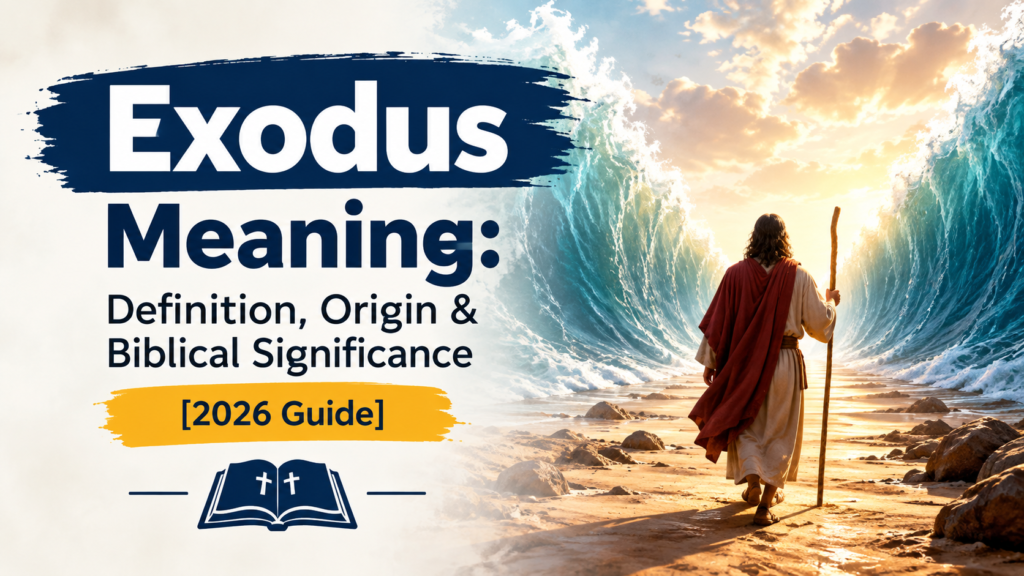

If you’ve ever heard someone say “there was a mass exodus from the city,” you’ve probably wondered where that word actually comes from. It sounds dramatic, almost cinematic. And honestly, it is.
This guide breaks down what exodus means, where the word originated, and why the story behind it still shapes language, culture, and faith today. No fluff, no guesswork — just clear answers backed by real sources.
What Is the Meaning of Exodus?
Exodus means a mass departure of people, usually a large group leaving a place at once. Capitalized, it also refers to the second book of the Bible.
Standard English dictionaries define it both ways: as the narrative second book of Jewish and Christian scripture, and separately as a general term for mass departure or emigration. So the word does double duty — it works as a book title and as an everyday noun.
In casual use, people say things like “the summer exodus to the beach” or “a corporate exodus of employees.” It just means a lot of people leaving at once, often because of pressure or opportunity elsewhere.
Where Does the Word “Exodus” Come From?
Exodus isn’t originally a Hebrew word — it’s Greek. It comes from exodos, meaning “the road out,” built from ex (out of) and hodos (road or way).
The word’s path into English runs through Latin, borrowed from that same Greek root meaning “the road out.” The original Greek term covered even more ground than just the Bible story — it could describe a military expedition, a formal procession, or simply a departure of any kind.
Here’s a fun bonus fact: several everyday English words share that same Greek root, hodos. Word-origin references note that “episode,” “method,” “period,” and “odometer” are all linguistic cousins of exodus. So the next time you glance at your car’s odometer, you’re technically using a distant relative of the word “exodus.”
What Is a Synonym for Exodus?
Common synonyms for exodus include departure, migration, flight, emigration, evacuation, and diaspora. Most of these words share the same core idea: a group leaving one place for another.
Close matches include flow, outflow, outpouring, emigration, flight, and rush, along with stronger options such as diaspora and stampede when the departure feels more urgent or chaotic. Other common substitutes are evacuation, exit, retreat, withdrawal, egress, and vanishment, depending on how dramatic or formal the writing needs to be.
Antonyms are worth knowing too, since they clarify the word by contrast. Common opposites include influx, inflow, flood, and inundation — basically, exodus describes people flowing out, while these words describe people (or things) flowing in.
If you’re writing and want variety instead of repeating “exodus” five times in one paragraph, “mass departure,” “migration,” or “flight” usually work well as natural substitutes, depending on tone.
Why Is the Second Book of the Bible Called Exodus?
The Book of Exodus is named for its central event: the Israelites leaving slavery in Egypt. Ancient Greek translators of the Hebrew scriptures chose the word exodos as the title because “departure” summed up the whole story.
The book’s name traces to that same Greek phrase for “a going out” or “marching out,” which fits perfectly since the book itself tells of the Israelites’ escape from Egyptian slavery.
Here’s the twist, though — the original Hebrew name for the book isn’t “Exodus” at all. The Hebrew title translates to “Departure from Egypt,” using entirely different wording. The Greek name only became standard because early Bible translators used it, and it eventually stuck in English translations too.
So in a sense, “Exodus” is a Greek nickname that outlived its Hebrew original — and today, that nickname is far more recognized worldwide than the actual Hebrew title ever was.
What Happens in the Book of Exodus?
The Book of Exodus covers the Israelites’ escape from Egyptian slavery, the ten plagues, the parting of the Red Sea, and the giving of the Ten Commandments at Mount Sinai. The book runs 40 chapters and splits roughly into two halves.
The first half, covering roughly chapters 1 through 18, follows Moses’ early life and calling, the plagues sent against Egypt, the first Passover, and the dramatic crossing of the Red Sea. The second half, chapters 19 through 40, shifts tone completely — it focuses on law, worship, and the detailed instructions for building the Tabernacle, including the golden calf incident along the way.
It’s genuinely a story with everything: oppression, rebellion, miracles, betrayal, and a fresh start. That range is probably why it’s been retold in films, sermons, and pop culture references for generations.
Who Led the Israelites Out of Egypt?
Moses led the Israelites out of Egypt after confronting Pharaoh and demanding their freedom. He’s the central figure throughout the entire book.
Traditional Jewish and Christian scholarship credits Moses as the key figure behind these events, and in many faith traditions, as the author of the account itself. The moment he stands before Pharaoh demanding the Israelites’ release is arguably the most referenced scene in the whole narrative — it’s been quoted in speeches, films, and civil rights movements for generations.
When Did the Exodus Actually Happen?
Historians and Biblical scholars don’t fully agree on an exact date. The two leading theories place it either in the 15th century BCE or the 13th century BCE.
Most scholars in this debate settle into one of those two camps, with roughly two centuries separating the theories. That’s a substantial gap by ancient-history standards.
Some researchers get more specific, pointing to around 1250 BCE as the most commonly cited date for the Exodus event, largely tied to references involving Pharaoh Ramesses II and Egyptian building projects mentioned in the text.
This debate isn’t close to resolved, either. Scholars have argued over the Exodus timeline for more than 150 years, producing two competing chronologies and no clear consensus. So if you’re hoping for one universally agreed-upon date, that’s simply not where current research stands.
Is There Archaeological Proof of the Exodus?
Direct archaeological proof of a mass Israelite exodus from Egypt hasn’t turned up. But that gap in the evidence doesn’t automatically prove the event never happened — it mostly reflects how hard it is to find physical traces of migrations from thousands of years ago.
Researchers who lean toward historicity often invoke a common principle in archaeology: the absence of evidence isn’t the same as evidence of absence, especially with events this old and this poorly documented by surrounding civilizations.
Other scholars take a different approach entirely, treating the story more as cultural memory passed down and reshaped over generations rather than a strict historical record. Both views, along with several other competing positions, sit side by side in modern academic discussion without a clear winner.
Basically, this is one of those topics where honest experts land in genuinely different places — and that disagreement doesn’t make the story any less meaningful to the billions of people who hold it as sacred.
What Were the Ten Plagues of Egypt?
The ten plagues were a series of disasters — including rivers turning to blood, swarms of locusts, prolonged darkness, and the death of firstborn sons — sent to pressure Pharaoh into freeing the Israelites. They’re described across several chapters of Exodus.
Interestingly, the plagues aren’t counted the same way everywhere in the Bible. Two other Biblical poems, found in Psalms 78 and 105, describe the plagues differently from the Exodus account and from each other, both in what counts as a “plague” and in what order they occurred. Some ancient writers even counted only seven, likely to tie the number symbolically to the seven days of creation.
That detail is a good reminder that even within religious tradition, storytelling and symbolic meaning often mattered just as much as strict numerical precision.
What Are the Ten Commandments, and Where Do They Come From?
The Ten Commandments are a set of ethical and religious laws that, according to the Bible, God gave to Moses at Mount Sinai. They appear in Exodus chapter 20 and again, with some differences in wording, in Deuteronomy chapter 5.
The Ten Commandments actually show up in three distinct versions across the Hebrew Bible, including a lesser-known version sometimes called the “Ritual Decalogue” found later in Exodus. Different religious traditions even divide the verses differently when counting out ten individual commandments.
These laws went on to become one of the most referenced ethical frameworks in Western history, showing up in courtrooms, legal debates, and films long after their original context.
What Is the Deeper Meaning of Exodus?
Beyond the literal story, Exodus is widely read as a symbol of liberation, redemption, and covenant — the idea that freedom comes paired with responsibility, not just release from hardship. That’s why the word still gets invoked far outside religious settings.
Theologically, two connected ideas run through the book: God acting to free the oppressed, and a resulting relationship built on mutual commitment. Exodus centers on redemption — God acting to free the oppressed — paired with covenant, meaning freedom comes bundled with responsibility and relationship. In other words, the story isn’t just about escaping something bad — it’s about moving toward a new kind of structured, accountable freedom.
This theme didn’t stay confined to ancient scripture, either. The Exodus narrative has directly shaped modern liberation movements. Its emphasis on liberation has served as a powerful symbol for religious and social movements, inspiring struggles for justice and freedom, including the American Civil Rights Movement.
How Is “Exodus” Used in Modern English Today?
Outside religious contexts, lowercase “exodus” simply means a large group leaving somewhere, often for economic, political, or lifestyle reasons — think “urban exodus” or “rural exodus.”
This everyday usage isn’t new, either. Language historians trace the general sense of “departure from a place,” especially referring to large-scale migration of people or animals, back to the 1620s. That’s roughly four centuries of casual, non-religious use.
You’ll also notice this word gets paired with “mass” constantly. “Mass exodus” typically signals that almost everyone leaves at the same time, rather than a slow trickle of departures.
So whether it’s office workers leaving a city, fans rushing out of a stadium, or an entire population relocating, “exodus” captures that same energy: a sudden, collective “we’re out.”
Can Exodus Be Used for Just One Person Leaving?
Technically, yes, but most editors consider that usage nonstandard. The word is really meant for groups, not individuals.
Some writers do use “exodus” for a single person’s departure, but that choice tends to raise eyebrows among editors who feel it should describe the departure of a large group only. So if you’re writing something formal, it’s safer to save “exodus” for crowds rather than solo exits.
Why Does the Meaning of Exodus Still Matter Today?
The word “exodus” continues to carry weight because it represents more than migration — it symbolizes liberation, transformation, and starting over. That emotional and cultural weight is exactly why the word gets borrowed so often outside religious writing.
It shows up in journalism (“tech talent exodus”), political commentary, and everyday conversation. Every time it’s used, it quietly borrows a bit of that original story’s emotional charge: struggle followed by freedom.
That’s honestly rare for a word with roots this old. Most ancient terms fade into textbooks and academic footnotes. This one is still doing active duty in news headlines today.
Frequently Asked Questions About Exodus Meaning
Is “Exodus” a Hebrew or Greek word? It’s Greek, not Hebrew. The Hebrew Bible originally used a different title for the book, but the Greek translation used exodos, and that name is what stuck in English.
What does exodus mean in the Bible specifically? In the Bible, it refers to the Israelites’ departure from slavery in Egypt, led by Moses, as told in the Book of Exodus.
How many chapters does the Book of Exodus have? The Book of Exodus has 40 chapters, split between the escape from Egypt and the later chapters on law, worship, and the Tabernacle.
Do historians agree on when the Exodus happened? No. Most scholars fall into either a 15th-century BCE or 13th-century BCE camp, and the debate has continued for well over a century without full consensus.
Can “exodus” be used outside religious contexts? Yes. It’s commonly used today to describe any large-scale departure of people, such as an urban exodus or a mass exodus from a company.
Final Thoughts
At its core, exodus means a big departure — whether that’s an ancient nation walking out of slavery or a modern city watching residents pack up and leave. The word carries centuries of history in just six letters, tracing back to a simple Greek phrase for “the road out.”
Understanding where it comes from doesn’t just make for good trivia. It connects a phrase you might use casually today to one of the most influential stories in religious and cultural history.