
You saw “ima” in a text, and now you’re stuck. Is it a typo? A mood? A secret code from Gen Z headquarters?
Relax. The ima meaning is simpler than it looks, and once you get it, you’ll spot it everywhere — texts, captions, song lyrics, even your group chat’s most chaotic member. If you’ve been searching what is the meaning of ima and getting confusing answers, this guide clears it up for good: what it means, where it came from, and how to use it without sounding like you just discovered texting in 2026.
What Does IMA Mean in a Text?
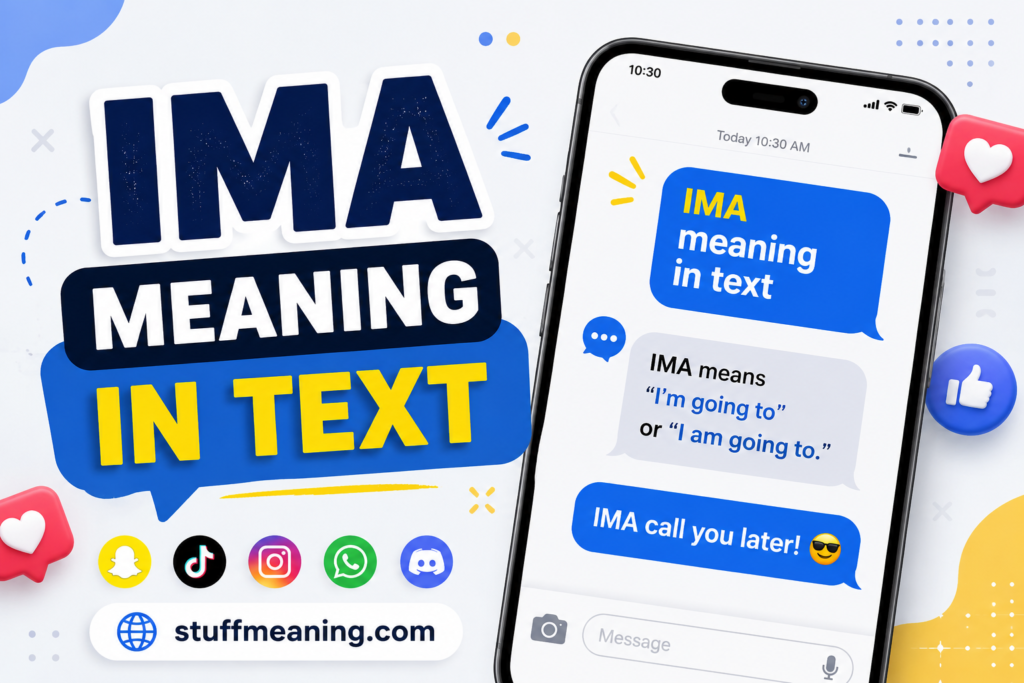
IMA means “I’m going to” or “I am going to.” It’s a casual, compressed way of saying you plan to do something, usually very soon.
Cambridge Dictionary lists the related spelling “imma” as a short form of “I’m going to,” used when someone wants to say what they intend to do next. That’s the core, dictionary-backed meaning of ima too — they’re the same word with different spelling.
So when a friend texts “ima call you after work,” they simply mean they’re about to call you. No hidden meaning, no drama. Just fast, informal English.
Quick examples:
- “Ima grab coffee, want anything?” → I’m going to grab coffee.
- “Ima be there in 10.” → I’m going to be there in 10 minutes.
- “Ima start packing tonight.” → I’m going to start packing tonight.
Where Did IMA Actually Come From?
IMA didn’t appear out of nowhere. It grew out of a long chain of sound-shortening in spoken English, especially African American Vernacular English (AAVE).
Linguist Lisa J. Green, in her book African American English: A Linguistic Introduction (Cambridge University Press), documents how AAVE uses preverbal markers like “finna” and similar future-tense shortcuts as a regular, rule-governed part of the dialect — not random slang. A University of Chicago linguistics paper on “finna” makes the same point: these forms follow real grammatical patterns, they’re just different from Standard English ones.
The everyday version of that shortening chain looks roughly like this:
- I am going to
- I’m gonna
- I’ma / Ima
- Imma
Each step drops a sound to make speaking faster. Texting culture then picked up the spoken form and typed it exactly how it sounds. That’s why “ima” reads like a phonetic shortcut — because that’s exactly what it is.
Over recent decades, hip-hop and R&B lyrics have carried the phrase well beyond its AAVE roots, helping it spread into everyday American slang, especially in texting and on social media.
Is It Okay to Use IMA If You’re Not a Native AAVE Speaker?
Yes, for casual everyday texting — but the honest answer is it depends on how you’re using it. IMA isn’t culturally neutral internet slang; it comes from a real dialect with its own grammar and history, and that context matters.
There’s a real difference between organic adoption and performance. Most people who type “ima” picked it up naturally through music, texting culture, or friends — the same way slang has always spread across communities that overlap and share media. That kind of everyday, low-key use is generally treated as normal because the word has spread so widely it now functions cross-dialectally.
The line gets crossed somewhere else: piling on exaggerated AAVE features for comic effect, or using them as a “costume” rather than just… talking. That reads very differently from typing “ima call you later” the same way you’d type “gonna.”
A simple way to think about it:
- Using “ima” the way you’d use any other casual contraction → generally fine.
- Using it alongside mockery, exaggerated stereotypes, or “putting on a voice” → this is where it becomes a problem.
This isn’t a strict yes-or-no rule, and anyone who tells you it is hasn’t thought about it very hard. It’s a spectrum, and that’s genuinely the most honest answer available.
The Grammar Behind IMA (Advanced Note)
This section goes deeper than most readers need — skip ahead if you just wanted the quick definition.
Technically, “ima” is the product of grammaticalization — a well-documented linguistic process where a full verb phrase gradually reduces into a fused grammatical marker. “Going to” didn’t randomly become “ima”; it followed a predictable path linguists have tracked for decades.
This isn’t unique to English, either. Spanish does the same thing with “ir a + infinitive,” and French does it with “aller + infinitive.” Movement verbs turning into future markers is a recognized cross-linguistic tendency, not an English quirk.
Here’s the part most articles miss entirely: “ima” doesn’t just mark future time — it marks prospective aspect, meaning the action is framed as already set in motion, not just hypothetically future. That’s the technical reason “ima call you” feels more locked-in than “I might call you.” The grammar itself encodes certainty, not just casual tone.
And this process isn’t finished. “Gonna” is currently undergoing the same kind of reduction that originally produced “ima” — which means the next generation of compressed future-tense slang is already quietly forming in casual speech right now.
Is IMA the Same as Imma or I’ma?
Yes — ima, imma, and I’ma all mean the same thing. They’re spelling variations of one spoken phrase, not three separate words.
There’s no official spelling because this is slang, not standard grammar. People write whichever version feels natural to them.
Here’s how they typically show up:
- Ima — the most common casual text spelling
- Imma — slightly more phonetic, common in captions and lyrics
- I’ma — closer to how it’s written in older song lyrics and scripts
Pick whichever one you like. Readers will understand all three the same way.
How Do People Actually Use IMA in Conversation?
People use IMA to announce a near-future action in a relaxed, unbothered tone. It works almost anywhere texting happens.
It shows up constantly in:
- Text messages between friends
- Social media captions and comments
- DMs on Instagram, Snapchat, and TikTok
- Song lyrics and casual dialogue
Real conversation example:
Friend: “You still coming tonight?” You: “Yeah, ima finish this assignment first.”
That’s the whole function of the word — it moves the conversation forward without extra typing. It’s basically “gonna” with a bit more attitude.
One thing worth noting: IMA is almost always about the very near future, not vague long-term plans. “Ima call you later” fits. “Ima retire early” reads more like a joke than a real statement, and that’s part of its charm.
Why Does Autocorrect Keep Changing “Ima” to Something Else?
Because most phone keyboards still treat “ima” as a typo of “I’m a,” not a word in its own right. That’s a software problem, not a “you’re texting wrong” problem.
Base autocorrect dictionaries on iOS and Android are built from formal-leaning language datasets, so standalone slang terms like “ima” often aren’t recognized as valid words — only as near-misses of standard phrases. Your phone is technically guessing, and it guesses wrong a lot here.
A few quirks worth knowing:
- Predictive text can “learn” your preferred spelling after you manually correct it enough times, but a software update or new device can wipe that local learning and reset the problem.
- Autocorrect sometimes capitalizes “Ima” mid-sentence, treating it like a proper noun (as in the name “Ima”) instead of lowercase slang.
- Voice-to-text tools like Siri and Google Assistant almost always transcribe spoken “ima” as “I’m a,” since speech recognition models lean heavily on formal training data rather than casual speech patterns.
- The fix: most phones let you add custom words or text replacements in keyboard settings — adding “ima” there stops it from getting silently rewritten.
Quick fix, step by step:
- Open your phone’s keyboard or text-replacement settings.
- Add “ima” as a custom word or shortcut.
- Type it correctly once or twice to reinforce it, since some keyboards still need a little repetition even after adding it manually.
What Does IMA Mean on Instagram, Snapchat, and TikTok?
On every major platform, IMA still means “I’m going to.” The meaning doesn’t change — only the setting does.
Instagram: Common in captions and DMs — “Ima post this later tonight.” Snapchat: Used for quick plans — “Ima send it in a sec.” TikTok: Shows up in comments and captions — “Ima try this trend.”
Social apps reward short, fast typing, so IMA fits naturally into that culture. It’s not platform-specific slang; it’s just informal English that thrives wherever people type quickly.
Does It Mean Something Different Coming From a Girl or a Guy?
No. IMA carries the same meaning regardless of who sends it. Any difference in tone comes from the person’s personality, not their gender.
A girl texting “ima call you later” and a guy texting “ima pull up in five” are doing the exact same grammatical thing — announcing a near-future action. Any extra warmth, sarcasm, or bluntness comes from context, punctuation, and emojis, not from the word itself.
If you’re trying to “decode” a text, look at the whole message and the relationship, not just one three-letter word.
What Does IMA Mean in Hebrew?
This one has nothing to do with texting. In Hebrew, “ima” (אמא) means “mom” or “mother.”
According to My Jewish Learning, “ima” and its counterpart “abba” (dad) are actually Aramaic in origin, not originally Hebrew, though they entered everyday Hebrew speech in ancient times and remain the common words Israeli children use for their parents today. The more formal, biblical Hebrew word for mother is “em.”
Wiktionary traces the word back even further, through Aramaic to Proto-Semitic roots — the same linguistic family that gave us many “mama”-style words across unrelated languages worldwide, since “m” and “b” sounds are some of the easiest for babies to make.
So if you ever see “Ima” in a Hebrew-language post or name, it almost certainly means mother, not “I’m going to.”
What Else Does IMA Stand For Outside of Texting?
Plenty. IMA is a busy acronym once you leave the group chat.
In business and finance: IMA stands for the Institute of Management Accountants, a global professional association founded in 1919. According to IMA’s own site, imanet.org, it now serves more than 140,000 members worldwide and issues the CMA (Certified Management Accountant) credential, a well-known certification in corporate finance.
In medicine: IMA refers to the internal mammary artery, also called the internal thoracic artery. Per a StatPearls (NCBI) clinical reference, this artery supplies the chest wall and is considered the gold-standard graft vessel used in coronary artery bypass surgery, largely because it holds up better over time than other graft options.
In other fields: IMA has also been used for organizations, museums, and technical terms — a reminder that three-letter acronyms get recycled a lot across industries.
Context is really the only tool you need here. In a text thread, IMA means “I’m going to.” In a cardiology report, it means an artery. On a resume, it might mean a professional credential.
Is IMA the Same as Gonna, Finna, or Imma?
Not quite — they overlap, but each carries a slightly different feel.
- Ima / Imma — “I’m going to,” a personal statement of near-future intent.
- Gonna — a more general, widely accepted shortening of “going to,” used by anyone in casual speech.
- Finna — rooted in AAVE, often implies something is about to happen even more immediately, sometimes translated as “about to” or “fixing to.”
Here’s the simplest way to remember it: “gonna” is casual for everyone, while “ima” and “finna” carry more specific dialectal roots and a stronger sense of “this is happening right now, no debate.”
Is It Okay to Use IMA in Professional or Formal Writing?
No. Save IMA for texts, DMs, and casual chats — not emails, resumes, or schoolwork.
It’s informal slang, and formal writing expects standard grammar. Using “ima” in a work email reads the same way as saying “gonna” out loud in a job interview — understandable, but out of place.
Safe to use:
- Texting friends and family
- Social media captions
- Casual group chats
Avoid using it:
- Emails to coworkers or clients
- School assignments
- Job applications or cover letters
When in doubt, write “I’m going to” instead. It costs you three extra words and saves you from looking careless in front of the wrong reader.
Common Mistakes People Make With IMA
Most confusion around IMA comes from three simple mix-ups.
Mistake 1: Confusing it with “I’m.” IMA always points to the future. “I’m tired” is present tense. “Ima sleep” is future tense. They’re not interchangeable.
Mistake 2: Using it in formal contexts. As covered above, this one just reads as unprofessional, not casual-cool.
Mistake 3: Assuming it has one fixed spelling. Since it’s slang, “ima,” “imma,” and “i’ma” are all acceptable and mean the same thing.
Has “Ima” or Similar Slang Ever Mattered in a Legal Case?
Yes — and it’s more serious than you’d expect. Casual future-tense slang has actually shown up in real courtrooms, where the exact tense of a sentence changed how evidence got treated.
In one real appellate case, a U.S. federal circuit court had to determine whether the statement “he finna shoot me” — a close grammatical cousin of “ima” — was made in the present tense or described a future event. That distinction mattered because it affected whether the statement qualified as an “excited utterance” under hearsay rules, and judges on the case actually disagreed about the answer.
Here’s why this matters for “ima” specifically: it functions the same grammatical way, marking imminent, already-decided action rather than a vague maybe. Courts treating these markers seriously — arguing over their exact tense — shows they aren’t “broken English.” They’re grammatically load-bearing enough to affect real legal outcomes.
The practical takeaway: text messages using constructions like “ima” have been introduced as evidence in real cases before. Tone and tense in casual texts can matter a lot more than people assume, especially if a conversation ever becomes relevant to something serious.
How Should You Reply When Someone Texts You IMA?
Just match the tone — IMA doesn’t need a complicated response.
If it’s about plans: “Cool, see you soon.” If it’s an update: “Got it, thanks for the heads up.” If it’s casual and friendly: “Bet 👍” or “Sounds good.”
There’s no wrong way to respond as long as your reply matches the relaxed energy of the message. Overthinking a three-letter text is, ironically, the least “ima” thing you could do.
Why Does Slang Like IMA Spread So Fast?
Texting habits are a big part of the answer. Pew Research Center reports that texting remains one of the most common daily activities on mobile phones, and by the mid-2020s, close to all American adults owned a cellphone and used it regularly to send messages. When that much daily communication happens by thumb instead of voice, shortcuts like “ima” spread quickly simply because they save time and match how people actually talk.
Add in music, memes, and social media captions constantly recycling the same casual phrases, and a word like IMA can go from regional dialect to nationwide texting habit within a generation.
Is IMA Still Popular, or Is It Fading Out?
IMA is still very much alive in everyday texting. It hasn’t been replaced — it’s just sharing space with newer slang.
Words like “finna” and “bet” trend up and down depending on the platform of the moment, but “ima” has stuck around because it’s short, easy to type, and doesn’t need explaining to most English speakers anymore. Dictionaries have taken notice too. Cambridge Dictionary now carries an entry for “imma,” clearly labeled as informal — not standard English, but recognized and defined all the same.
That kind of dictionary recognition still matters. It usually means a slang term has been in steady, widespread use long enough that lexicographers can no longer treat it as a short-lived trend. IMA earned that spot the same way plenty of other informal terms eventually do — through years of consistent, everyday use, even while staying casual by nature.
IMA Myths vs. Reality: What People Get Wrong
A lot of what people believe about “ima” doesn’t hold up once you actually look into it.
|
Myth |
Reality |
| “Ima” is brand-new Gen Z slang |
It’s a much older construction rooted in AAVE, documented in linguistics literature well before texting even existed |
|
It’s just “bad grammar” |
Linguists classify it as a rule-governed grammatical marker, not a mistake — it follows consistent patterns |
| “Ima” and “Imma” are interchangeable everywhere |
True for casual texting, but spelling can matter when tracking usage in dictionaries and formal citations |
|
It only signals things happening in the next few seconds |
It signals near-certain intent, which can mean minutes, hours, or later the same day depending on context |
| Anyone can use it the same way, in any setting, with zero social read |
How it lands can genuinely depend on who’s speaking, the setting, and the tone around it |
Once you see the reality side of this table, “ima” stops looking like a throwaway internet abbreviation and starts looking like what it actually is: a small, functional piece of everyday grammar with real linguistic and even legal weight behind it.
Frequently Asked Questions About IMA
What does IMA mean in a text message? It means “I’m going to” or “I am going to,” used to describe something you plan to do soon.
Is IMA rude or offensive? No. It’s informal, not disrespectful. It simply doesn’t belong in formal writing.
Is IMA the same as Imma? Yes, they’re spelling variations of the same phrase and mean the same thing.
What does IMA mean in Hebrew? It means “mom” or “mother,” and it’s unrelated to the texting slang.
What does IMA stand for besides texting slang? It can refer to the Institute of Management Accountants in finance, or the internal mammary artery in medicine, depending on context.
Can I use IMA in a work email? It’s best to avoid it. Write “I’m going to” or “I will” instead in professional settings.
Does IMA mean something different on Snapchat or TikTok? No, the meaning stays the same across every platform — it’s just the setting that changes.
The Bottom Line
At its core, the ima meaning comes down to one simple idea: it’s a fast, informal way of saying “I’m going to.” It grew out of natural speech patterns in American English, spread through music and texting culture, and now shows up everywhere from Snapchat captions to song lyrics.
Outside of texting, the same three letters point to completely different worlds — a Hebrew word for mom, a finance credential, or a key artery in heart surgery. Context always tells you which one you’re dealing with.
Next time “ima” pops up in your messages, you won’t need to Google it mid-conversation. You’ll just know — and honestly, ima call that a win.