
Quick answer
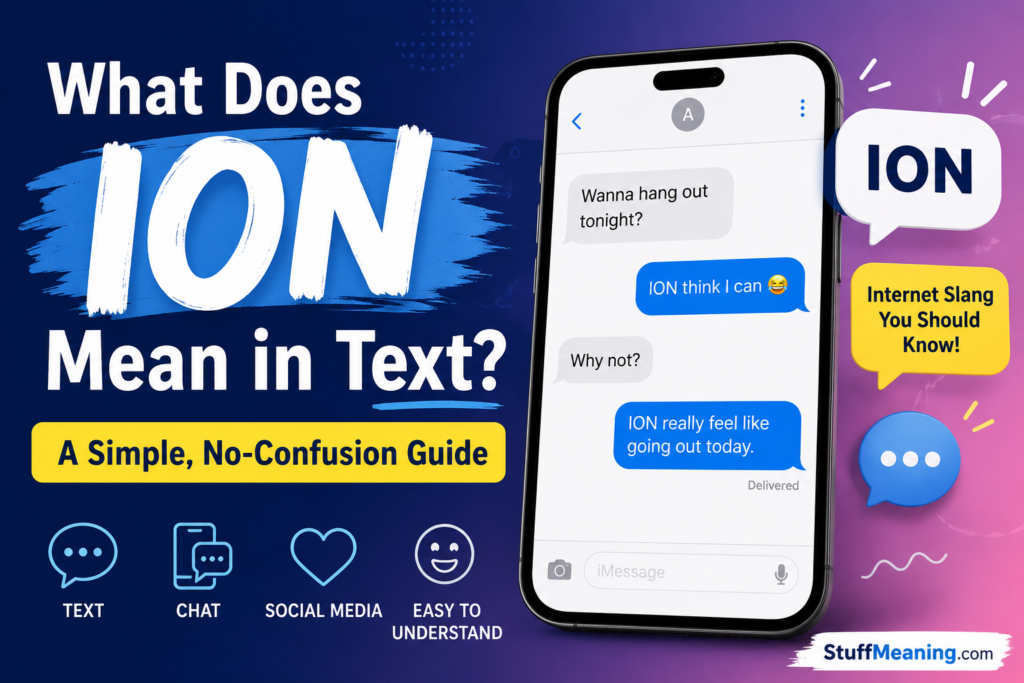
In texting and on social media, “ion” means “I don’t.” It’s a phonetic spelling of how people naturally say “I don’t” out loud — fast, casual, and without the apostrophe. So “ion know” simply means “I don’t know.”
If you just got a text that said “ion care” and immediately Googled it out of pure confusion, welcome. You’re in good company. This little four-letter word trips up a lot of people the first time they see it, mostly because it also happens to be a real science term.
Good news: once you know the trick, you’ll never second-guess it again. Let’s break it down properly.
What Does ION Mean in Text?
ION (lowercase “ion”) stands for “I don’t.” People type it exactly the way it sounds when spoken quickly in casual conversation. Say “I don’t know” out loud fast, and it comes out sounding a lot like “ion-oh.”
This isn’t a random abbreviation someone made up for fun. Dictionary.com traces the slang directly to Black English, where “I don’t” is often pronounced as a quick, blended sound rather than two crisp words. Texting simply wrote down what people were already saying.
So when a friend texts “ion feel like cooking tonight,” they mean “I don’t feel like cooking tonight.” Nothing more mysterious than that.
The confusion usually happens because “ion” is also a real word — the kind you learned about in chemistry class. We’ll get to that shortly, because it matters more than most slang guides admit.
What Does ION Mean in a Text Message, Specifically?
In a text message, ION almost always replaces “I don’t” at the start of a sentence. It’s a stand-in for the full phrase, not a separate word with its own meaning.
Think of it the same way “gonna” stands in for “going to.” It’s not new grammar. It’s just spoken English typed the way it sounds.
Here’s the pattern to watch for:
- “ion” + verb = “I don’t” + verb
- Example: “ion trust him” = “I don’t trust him”
- Example: “ion mind either way” = “I don’t mind either way”
Once you spot that pattern, decoding any sentence with “ion” in it becomes automatic.
A Brief History of ION
ION started as a written version of spoken African American Vernacular English (AAVE), where “I don’t” naturally compresses into a single, fast sound. Texting culture picked it up and ran with it.
Here’s the timeline, in short:
- 1834 — British scientist Michael Faraday first identifies ions in chemistry, atoms or molecules that carry an electric charge, according to Merriam-Webster. This is the original, scientific meaning of the word.
- 2000s — According to Dictionary.com’s slang dictionary, “ion” as a spelling of “I don’t” starts appearing in early internet writing and forums, reflecting how the phrase already sounded in casual spoken English.
- Late 2000s–2010s — Twitter helps push the slang spelling into mainstream internet culture, where short, phonetic spellings were already common due to character limits.
- 2020s — TikTok, Snapchat, and Instagram turn ION into everyday texting shorthand, especially among teens and young adults who favor fast, informal replies over full sentences.
Two completely different meanings, born nearly 200 years apart, just happen to share the same three letters. That’s really the whole story behind the confusion.
So if your chemistry teacher texts you about “ions” in cell membranes, that’s the 1834 meaning. If your friend texts “ion wanna go to that party,” that’s the internet-era slang. Context always sorts it out fast.
Is ION the Same as the Science Word “Ion”?
No. They’re spelled the same but mean completely different things depending on context. Science “ion” is about electric charge. Slang “ion” is about saying “I don’t.”
An ion, in chemistry, is an atom or group of atoms that carries a positive or negative charge because it has gained or lost electrons, per Merriam-Webster’s dictionary definition. That’s a real, measurable thing you’ll find in a periodic table lesson or a battery diagram.
In a text message, though, capitalization and context tell you everything. Nobody texts their friend “ion” to talk about electron transfer. If it shows up in a casual sentence with no science talk around it, it means “I don’t” — every time.
What Does ION Mean in All Caps?
Written in all caps, ION can occasionally mean “In Other News” — a phrase people use to change the subject in a conversation. This use is older and far less common than the lowercase slang meaning.
Dictionary.com notes that this all-caps version of ION shows up mostly in older internet forums and early social media posts, often as a way to pivot the topic mid-conversation, similar to saying “anyway” or “on another note.”
You’ll rarely see this version in modern texting. If you do come across it, the sentence usually reads more like an announcement than a casual reply, which is your biggest clue.
Quick comparison:
|
Form |
Common Meaning | Where You’ll See It |
| ion (lowercase) | I don’t |
Texts, DMs, TikTok, Snapchat |
|
ION (all caps) |
In Other News | Older forums, rare in texting |
| ion (science) | Charged atom |
Chemistry, physics, science class |
How Do People Actually Use ION in a Sentence?
People use ION the exact same way they’d use “I don’t” — just faster and more casual. It works with almost any verb that would normally follow “I don’t.”
Here are some real, everyday examples:
Notice the tone stays relaxed across all of these. That’s really the whole point of ION — it signals “I’m texting you like I talk, not like I’m writing an essay.”
When Should You Use ION (and When Should You Not)?
Use ION in casual chats with friends, in group texts, and on social media. Skip it completely in work emails, school assignments, and any conversation where you want to be taken seriously.
Slang like this works because everyone in the conversation is playing by the same casual rules. The moment the setting gets formal, ION reads as sloppy instead of relaxed.
Good places to use it:
-
-
-
- Texting friends or close family
- Instagram or TikTok comments
- Snapchat captions
- Discord or gaming chats
-
-
Places to avoid it:
-
-
- Work Slack or email
- Messages to teachers or professors
- Job applications or cover letters
- Any message to someone who doesn’t text in slang
-
A simple rule that never fails: if you’d hesitate to say “I don’t” out loud in that setting, don’t text “ion” either.
Is ION Rude or Disrespectful?
ION itself isn’t rude — it’s just casual. But paired with certain words, it can come across as dismissive or blunt, especially in text where tone is already hard to read.
“ion care” is the classic example. Said with a laughing emoji among friends, it’s harmless. Sent flat, with no context, during a serious conversation, it can land as cold or uninterested.
The fix isn’t avoiding ION altogether — it’s paying attention to the conversation you’re in. Slang carries tone from the relationship, not just the words themselves.
ION vs. IDK vs. IDC: What’s the Difference?
ION, IDK, and IDC all sound similar, but they’re not interchangeable. Each replaces a slightly different phrase, and mixing them up can shift your meaning.
|
Slang |
Full Meaning | Best Used When |
| ION | I don’t |
General negation, before any verb |
|
IDK |
I don’t know | Specifically about not knowing something |
| IDC | I don’t care |
Specifically about indifference |
So “ion know” and “idk” mean the same thing and are fully interchangeable. But “ion think so” doesn’t have a clean IDK or IDC substitute — it’s just its own phrase.
ION on Social Media: A Platform-by-Platform Guide
ION means the same thing everywhere it shows up online. Only the tone and typical use case shift slightly depending on the app you’re using.
Here’s a quick guide to how it plays out across the platforms you’ll actually see it on.
ION on Snapchat
On Snapchat, ION usually shows up in quick chat replies and captions. It fits the app’s whole vibe — fast, casual, gone in a second.
A typical example: “ion know if I can make it 😭” as a reply to a plan someone’s proposing. Short, relaxed, no pressure attached.
ION on TikTok
On TikTok, you’ll mostly see ION in the comments section, often reacting to a video. It’s used to agree, disagree, or brush something off in a low-effort, in-the-know way.
Example: “ion think this trend is it” under a video. It reads as an opinion, not a rule.
ION on Instagram
On Instagram, ION shows up in both DMs and comments, usually paired with an emoji to soften or emphasize the point. It works the same in a caption as it does in a reply.
Example: “ion care what anyone says, this fit is fire 🔥.” The slang carries the casual, confident tone the caption is going for.
ION on Twitter/X
On Twitter/X, ION has deep roots — this is one of the platforms that helped the slang spelling spread in the first place, largely thanks to character limits rewarding short phrases.
Example: “ion get why people still argue about this” is a common structure for a quick opinion post.
ION on Discord and Gaming Chats
In Discord and in-game chats, ION tends to show up mid-conversation, keeping pace with fast group banter. Speed matters more here than anywhere else, since group chats move quickly.
Example: “ion have ammo, cover me” during a match is a normal, functional use — no different from typing “I don’t have ammo,” just faster.
Across every platform, the meaning never changes. Only the personality and pace built around it does.
Other Slang That Works Like ION
ION isn’t the only shorthand for negation floating around in texts. A few others show up constantly, and knowing the difference helps you read tone more accurately.
|
Slang |
Meaning | Feels Like |
| ion | I don’t |
Neutral, flexible |
|
nah |
No | Blunt, quick |
| ain’t | Am not / is not |
Informal, regional |
|
not rlly |
Not really | Soft disagreement |
| meh | Indifferent |
Low enthusiasm |
None of these are wrong or “bad English” — they’re just built for speed and tone, the same way “gonna” or “wanna” are. Texting has its own grammar, and ION fits right into it.
Why Did ION Become So Popular?
ION took off because it matches how younger generations already communicate: fast, informal, and closer to spoken language than traditional writing. Texting habits made it stick.
U.S. teens send an enormous number of messages every day, and nearly all of them are glued to a phone doing it. A 2024 Pew Research Center survey found that most U.S. teens have access to a smartphone, and close to half say they’re online almost constantly. That kind of constant, rapid-fire texting rewards short, phonetic spellings like ION over full sentences.
Platforms built for quick replies made it worse (in a good way). The same Pew Research data shows that roughly six in ten teens use TikTok and Instagram, with just over half using Snapchat — three apps built entirely around fast comments and captions, exactly where slang like ION thrives.
Add in the sheer volume of daily texting, and the math makes sense. When you’re firing off dozens of messages a day, “ion” beats typing out “I don’t” every single time.
Frequently Asked Questions About ION
Does ION always mean “I don’t”?
In lowercase, yes — that’s the meaning in nearly every text or caption. The all-caps “In Other News” version and the science definition are far less common and usually obvious from context.
Is ION the same as IDK?
Not exactly. ION means “I don’t” in general, while IDK specifically means “I don’t know.” They overlap in phrases like “ion know,” but ION works with many more verbs than IDK does.
Can I use ION at work or in emails?
It’s best to avoid it. Stick with “I don’t” or “I’m not sure” in professional messages, so your writing stays clear and appropriate for the setting.
Is ION only used by younger people?
It’s most common among teens and young adults, largely because texting habits and social media use skew younger, but plenty of adults use it casually with friends too.
Where did ION come from originally?
It comes from the natural pronunciation of “I don’t” in Black English, later adopted into wider internet slang starting in the 2000s and popularized by texting and social media.
Is ION a typo?
No. It’s a deliberate, phonetic spelling — not a mistake. It reflects how the phrase actually sounds when spoken quickly and casually.
The Bottom Line
ION means “I don’t,” full stop, in nearly every texting or social media context you’ll run into. It’s casual, quick, and rooted in how people actually talk, not in random internet noise.
Save the full “I don’t” for anything formal, and feel free to use ION everywhere else. Next time someone texts “ion know 🤷,” you won’t need to Google it — you’ll just know.