You’re scrolling through a text thread, and there it is: LMY Meaning. No explanation, no emoji, just three letters at the end of a sentence.
You’re not imagining things. This abbreviation shows up constantly in DMs, group chats, and Snapchat streaks. And if you’re over a certain age (or just new to texting slang), it looks like a typo.
It isn’t. LMY has a real, well-documented meaning, and this guide breaks it down properly — no guesswork, no filler.
Quick Answer: What Does LMY Mean in Text?
LMY stands for “Love and Miss You.” It’s a casual, affectionate sign-off people use in texts, DMs, and social posts to tell someone they’re loved and thought about, all in three keystrokes.
Dictionary.com’s acronym database backs this up directly, describing LMY as textspeak for “love and miss you,” placing it in the same family as XOX and “I love you to the moon and back.”
You’ll usually spot it at the end of a message, right after someone shares an update or says goodnight. Think of it as a warmer, more personal cousin of “talk soon.”
LMY Meaning in Chat and Texting
In everyday texting, LMY works as a closer. It wraps up a conversation on an emotional note instead of leaving things flat.
Here’s the pattern most people follow:
- Send a normal update or plan.
- Add “LMY” at the end as a small, genuine touch.
- Sometimes pair it with a heart emoji for extra warmth.
So a text like “Landed safe, heading home now, LMY” reads as: I’m fine, and I’m thinking about you too. That’s the whole job of the abbreviation — packing feeling into a message without slowing anyone down.
Texting culture rewards speed. Nobody wants to type “I love you and I miss you” every single time. LMY solves that problem in three letters.
Where LMY Came From
Text abbreviations didn’t appear overnight. They grew out of decades of shorthand, starting with early SMS character limits and internet chatrooms in the late 1990s and 2000s.
Terms like LOL, BRB, and ILY set the pattern first: strip a common phrase down to its initials. LMY followed the same logic, just applied to a slightly longer, more emotional phrase.
Word Counter’s research on the term notes that Urban Dictionary users have suggested LMY may have started as a misspelling of “IMY” (I Miss You) that eventually stuck around as its own phrase. Language does this often. A typo gets repeated enough times, and it turns into an accepted term.
Whatever the exact origin, the meaning has settled firmly on “love and miss you” across major slang references, including Urban Dictionary itself.
LMY Meaning on Social Media
Social platforms didn’t invent LMY, but they definitely gave it a bigger stage. Character limits and fast-scrolling feeds reward short, emotional phrases, and LMY fits that mold perfectly.
Here’s a quick breakdown of how it typically shows up across platforms:
|
Platform |
Common Use Case | Typical Tone |
| Snapchat | End of a streak message or private snap caption |
Personal, affectionate |
|
|
Comment on a friend’s or partner’s post, or a DM sign-off | Warm, casual |
| TikTok | Comment section replies to friends or creators they follow closely |
Friendly, sometimes playful |
|
Text Messages (SMS) |
Closing line after plans, updates, or goodnight texts |
Genuine, straightforward |
On Snapchat especially, LMY fits the platform’s fast, disappearing-message style. It says everything that matters in the time it takes to swipe.
On Instagram and TikTok, people often drop it in comments to show they still care about someone even without a long, public message. It’s a low-effort, high-warmth move.
Other Meanings People Associate With LMY
Slang rarely has just one interpretation, and LMY is no exception. A handful of variations float around online, so it’s worth knowing them before you hit send.
“Love You More.” Some texting guides describe LMY as a playful reply to “ILY” (I Love You), essentially one-upping the other person’s affection. This usage exists, but it’s less consistently documented across major slang dictionaries than “Love and Miss You.”
A typo for “LMK.” Because L, M, and Y sit near K on a phone keyboard, LMY sometimes appears as an accidental misspelling of “LMK” (Let Me Know). If a message reads “LMY if you’re free Friday,” it almost certainly means “let me know,” not “love and miss you.”
The fix here is simple: read the sentence around it. A message about feelings usually means the affectionate version. A message about plans, schedules, or requests usually means the typo version.
How to Use LMY in a Sentence
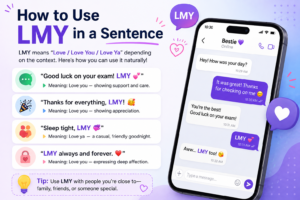
Seeing examples makes this a lot easier to apply. Here are a few natural ways LMY shows up in real conversations:
Real-Life Examples of LMY in Conversation
Reading a definition is one thing. Seeing how LMY actually plays out in a real chat makes it click a lot faster. Here are a few realistic scenarios.
Example 1: Long-distance couple, goodnight text
Jake: Long day, heading to bed now Jake: LMY, talk tomorrow ❤️ Mia: Sleep well, love you too!
Here, LMY closes out the day on a soft note without turning a quick goodnight text into a whole paragraph.
Example 2 : Best friends after a busy week
Sara: Sorry I’ve been MIA, work has been insane Sara: LMY though, we need to catch up soon Priya: LMY too! Coffee this weekend?
Between friends, LMY works as a quick way to say “I still care, even though we haven’t talked much.”
Example 3 : Instagram comment on a family post
Comment under a mom’s birthday photo: “Happy birthday!! LMY 🥹”
This is a common way people show affection publicly without writing a long, emotional comment on a photo.
Example 4: Snapchat streak message
Text under a selfie snap: “just got home, LMY”
Short, casual, and typical of how Snapchat conversations move fast between close friends or partners.
Example 5: The LMK mix-up in action
Manager: Are you free for a call at 3pm? LMY Employee: (confused, replies) Did you mean LMK?
This one shows exactly why context matters. In a scheduling message like this, LMY is almost certainly a typo for “Let Me Know,” not an expression of affection, especially since it showed up in a work message, where “love and miss you” wouldn’t make sense anyway.
LMY Meaning From a Girl vs. From a Guy
Here’s the honest answer: the core meaning of LMY doesn’t change based on who’s typing it. “Love and miss you” means the same thing whether it comes from a girlfriend, a best friend, a brother, or a coworker who’s genuinely fond of you.
What changes is context, not definition. A romantic partner sending LMY after a video call likely means it in a couple-y, intimate way. A close friend sending it after a long week of not talking probably just means platonic affection.
Rather than trying to decode gender into the acronym itself, look at the relationship and the rest of the conversation. That tells you far more than who typed the message.
LMY vs. Similar Texting Abbreviations
LMY sits inside a bigger family of affectionate texting shorthand. Comparing it to its relatives makes the meaning even clearer.
|
Abbreviation |
Full Meaning | Typical Use |
| LMY | Love and Miss You |
Sign-off, affectionate closer |
|
ILY |
I Love You | Direct statement of feeling |
| IMY | I Miss You |
Expressing longing specifically |
|
ILYSM |
I Love You So Much | Stronger, more emphatic version of ILY |
| LY | Love You |
Quick, casual affection |
|
XOXO |
Hugs and Kisses | Warm, friendly or romantic closer |
Notice that LMY basically combines ILY and IMY into one compact package. That’s exactly why it works so well as a closing line: two feelings, one acronym.
When You Shouldn’t Use LMY
LMY belongs in casual, personal spaces. It does not belong everywhere.
Skip it in:
- Work emails or professional Slack messages
- Messages to people you barely know
- Formal written communication like cover letters or reports
- Customer service or business texting threads
Use it freely with:
- Close friends
- Family members
- Romantic partners
- People who already text you casually and affectionately
A good rule of thumb: if you wouldn’t say “I love and miss you” out loud to that person, don’t send LMY either. The abbreviation is casual, but the sentiment behind it is still real.
Common Mistakes People Make With LMY
A few slip-ups happen often enough that they’re worth flagging directly.
Sending it to the wrong audience. Dropping LMY on a coworker or a new acquaintance can come across as oddly intense, since the phrase carries genuine emotional weight.
Confusing it with LMK. As mentioned earlier, this mix-up happens constantly because of how close the letters sit on a keyboard. When in doubt, reread the sentence for context clues.
Overusing it until it loses meaning. Sending LMY in every single message can flatten its impact. Like most affectionate language, it lands better when it’s not automatic.
Why LMY Has Stuck Around
Texting rewards efficiency, but people still want their messages to feel human. LMY threads that needle perfectly: short enough for a quick text, warm enough to actually mean something.
It also fits naturally into a wider shift in digital communication, where full sentences increasingly give way to shorthand that still carries emotional weight. LOL didn’t kill humor, and LMY hasn’t killed sincerity, it just compressed it.
As long as people keep texting the ones they care about, expect LMY to stick around in group chats, comment sections, and goodnight texts for a while yet.
Frequently Asked Questions
What does LMY mean in a text message? LMY stands for “Love and Miss You.” It’s a short, affectionate closer used between friends, family, and romantic partners.
Is LMY the same as LMK? No, though they’re often confused because of keyboard proximity. LMK means “Let Me Know,” while LMY means “Love and Miss You.” Context usually clarifies which one someone meant.
Can LMY mean “Love You More”? Some sources describe this as an alternate meaning, mainly used as a playful reply to “ILY.” It’s less widely documented than “Love and Miss You,” so context matters here too.
Is it okay to use LMY with a friend, not just a partner? Yes. LMY works fine between close friends and family members. It isn’t limited to romantic relationships.
Should I use LMY in professional messages? No. Keep it to personal, casual conversations. It doesn’t fit workplace or formal communication.
Where is LMY most commonly used? You’ll see it most on SMS texts, Snapchat, Instagram DMs and comments, and TikTok comment sections, generally anywhere casual, personal messaging happens.
Final Thoughts
LMY isn’t complicated once you break it down: it simply means “love and miss you,” dressed up in three letters for speed. It shows up at the end of texts and comments as a small, genuine gesture, not a mystery code.
The next time it lands in your inbox, you’ll know exactly what it means, and maybe even send it back.