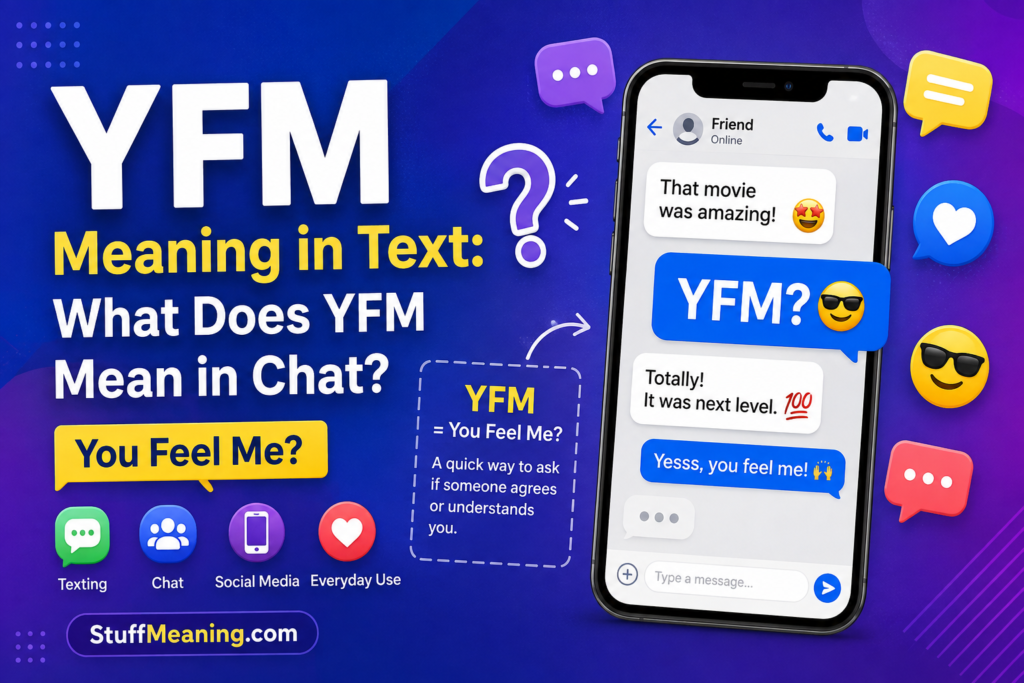

You’re scrolling through a text, and there it is: YFM. No context, no emoji, just three letters staring back at you. So you pause. You reread the sentence. You wonder if you missed something.
Relax. You didn’t miss anything. You just ran into one of the many short abbreviations that make up everyday texting slang, and this guide clears it up in plain English.
Quick Answer
It’s a casual way of asking someone if they understand, relate to, or agree with what was just said. Think of it as a digital version of “get what I’m saying?” or “does that make sense?”
That’s the short version. But YFM has a few layers worth knowing, especially since the meaning can shift slightly depending on the app, the person, and the mood of the conversation. Let’s break it down properly.
YFM Meaning in Texting: The Core Definition
At its core, YFM meaning in texting comes down to checking for connection. When someone types YFM after a statement, they’re basically asking: “Are we on the same page?”
Here’s a simple example:
The person isn’t literally asking about your feelings. They’re asking if you agree, or if you’ve experienced something similar. It’s a small phrase, but it does a big job of keeping a conversation warm and two-way instead of one-sided.
This is why YFM shows up so often in casual chats. People type fast, and a three-letter check-in is a lot quicker than typing out “do you know what I mean by that?”
Where Did YFM Come From?
Slang like this doesn’t appear out of nowhere. The phrase “you feel me” has roots in African American Vernacular English (AAVE) and has been part of everyday spoken conversation for decades, long before texting existed. Musicians, especially in hip-hop and R&B, have used “you feel me” in lyrics and interviews for years as a way to seek agreement or emotional connection with the listener.
As texting and messaging apps became the main way people talk, spoken phrases like this naturally got abbreviated. “You feel me” turned into YFM the same way “laughing out loud” turned into LOL or “be right back” turned into BRB. It’s simply language adapting to a faster medium.
YFM Meaning on Social Media
Texting slang rarely stays in one place. Once a phrase catches on, it spreads across every platform people use to talk. YFM is no exception.
YFM Meaning on Snapchat
On Snapchat, YFM keeps its usual meaning. Since Snapchat conversations tend to be quick, back-and-forth, and often between close friends, YFM fits right in as a way to check if the other person is following along or agrees with a story.
YFM Meaning on Instagram
On Instagram, you’ll often spot YFM in comments or captions. Someone might post a relatable moment and caption it with “when Monday hits different, YFM?” It works almost like asking followers to relate to the post.
YFM Meaning on TikTok
TikTok comment sections are full of shorthand, and YFM is common there too. Creators sometimes use it directly in captions to invite viewers to agree with a joke or an opinion, almost like a mini call-to-action for engagement.
YFM Meaning on Facebook
Facebook skews toward a slightly older audience, so YFM shows up less often, but it still appears in comment threads, especially among younger users or in group chats attached to Facebook Messenger.
YFM Meaning in WhatsApp
In WhatsApp chats, YFM plays the same role as anywhere else: a quick nudge asking whether the other person understands or relates. WhatsApp being a more personal, closed-group app, YFM here often carries a friendlier, more familiar tone since it’s usually used between people who already know each other well.
Is There More Than One YFM Meaning?
Yes, and this is where things get a little interesting. While “You Feel Me?” is by far the most common interpretation, context can shift the meaning slightly.
YFM as “You For Me?”
In flirty or dating conversations, some people use YFM to mean “You For Me?” This version pops up mostly on dating apps or in the early stages of texting someone you’re interested in. It’s a playful way of asking if the other person is into you.
Example:
Here, the tone leans more romantic than the standard “do you understand me” usage.
Context Decides the Meaning
The honest truth is that texting slang rarely comes with a rulebook. YFM’s meaning depends heavily on:
- Who is texting you
- The relationship you have with them
- The rest of the sentence or conversation
- Whether emojis or punctuation give extra clues
If your best friend sends YFM after venting about a rough day, they almost certainly mean “you feel me.” If someone you just matched with on a dating app sends it after a flirty back-and-forth, “you for me” is more likely the intended meaning.
YFM Meaning in Text From a Girl vs. From a Guy
People sometimes ask if YFM means something different depending on who sends it. The honest answer is: not really. The core meaning stays the same regardless of gender. What changes is the surrounding tone.
From a girl:
This usually reads as looking for agreement or emotional understanding.
From a guy:
Same structure, same intent, just a different flavor of conversation. The gender of the sender changes the vibe, not the definition.
How to Respond When Someone Says YFM
This part trips people up more than the definition itself. Since YFM is usually rhetorical, you don’t always need to answer it literally. Still, a good response keeps the conversation flowing.
Here are a few natural ways to reply:
If YFM was used in a flirty context, a playful “maybe 👀” or “depends, convince me” keeps things light without overthinking it.
The main thing to remember: YFM is a connection-seeking phrase, not a demand for a formal answer. Responding with genuine agreement or a quick acknowledgment is usually all that’s needed.
Examples of YFM in a Text Conversation
Seeing the phrase in context makes it click faster than any definition alone. Here are a few realistic exchanges:
Example 1 — Everyday chat
Example 2 — Venting to a friend
Example 3 — Social media caption
Example 4 — Flirty texting
Each example shows the same pattern: a statement, followed by a check for agreement or connection.
When You Should (and Shouldn’t) Use YFM
YFM works well in casual settings: texting friends, chatting on social media, gaming conversations, or light banter. It adds personality and keeps a conversation from feeling like a monologue.
It does not belong in formal or professional communication. Sending YFM in a work email, a school assignment, or a message to someone you don’t know well can come across as too casual or even confusing to people unfamiliar with the term.
A simple rule of thumb: if you’d naturally say “you know what I mean?” out loud in that situation, YFM is probably fine in text. If the setting calls for a formal tone, skip the slang entirely.
YFM vs. Similar Texting Abbreviations
Texting slang often clusters around similar ideas. Here’s how YFM compares to a few related abbreviations people often confuse it with.
| Abbreviation | Meaning | Common Use |
| YFM | You Feel Me? | Checking for understanding or agreement |
| YFMM | You Feel Me More? | An intensified version of YFM, used for emphasis |
| FYM | What are you talking about? | Often more confrontational than YFM |
| YFW | Your Face When | Used in memes and reaction posts |
| IKR | I Know, Right? | Agreeing enthusiastically with a statement |
Knowing these differences matters. FYM, for instance, is easy to mix up with YFM at a glance, but it usually carries a sharper, more argumentative tone. YFM, on the other hand, stays friendly and open-ended almost all the time.
Is YFM Offensive or Safe to Use?
No, YFM is not offensive. It’s informal slang, nothing more. There’s no hidden rude meaning behind it, which makes it generally safe across most casual conversations, including with younger audiences. As with any slang, tone and context still matter. A message can feel pushy if it’s paired with aggressive wording, but that comes from the surrounding message, not the abbreviation itself.
Why Texting Slang Like YFM Exists in the First Place
It’s worth zooming out for a second. Texting abbreviations exist because typing full sentences over and over gets tiring, and honestly, a little boring. Slang like YFM keeps digital conversations feeling natural, quick, and personal, almost like actual spoken conversation instead of a formal, stiff message.
Without shortcuts like this, chats would read more like emails than conversations. YFM, along with terms like LMK, IKR, and BRB, keeps texting feeling human. And that’s really the whole point of slang: not to confuse people, but to communicate faster among people who already speak the same casual language.
Conclusion
So, next time YFM lands in your inbox or comment section, you’ll know exactly what’s going on. Nine times out of ten, it means “you feel me?” — a friendly check-in asking if you’re following along or if you relate to what was just said. In flirtier contexts, it might lean toward “you for me?” instead.
Either way, it’s harmless, casual, and part of the everyday shorthand that keeps online conversations moving. Understanding it helps you read the room (or the chat) a little better, and maybe even use it yourself the next time you want a quick way to ask, “get what I mean?”
FAQs
What does YFM mean in a text message? YFM usually means “You Feel Me?” It’s a casual way of asking if the other person understands, agrees, or relates to what you just said.
What does YFM mean on social media? The meaning stays the same across Snapchat, Instagram, TikTok, and Facebook. It’s used in captions, comments, and DMs to invite agreement or spark a sense of relatability.
What does YFM stand for in texting? It stands for “You Feel Me?” Some people also stretch it slightly to “You Feeling Me?” depending on personal texting style, but the intent doesn’t change.
Is YFM a slang word? Yes. It’s informal texting slang, not a formal word or phrase you’d find in a dictionary of standard English. It belongs strictly to casual conversation.
How is YFM used in texting? It’s typically added at the end of a sentence, almost like a rhetorical question, to check if the listener is on the same page. Example: “That was a long day, YFM?”
Is YFM offensive? No. It carries no rude or hidden meaning. It’s simply informal slang, safe for casual conversations, including with younger audiences.
Should I use YFM in professional messages? No. Save it for casual texts, social media, and friendly chats. In work emails or formal writing, it can come across as unprofessional or confusing.